
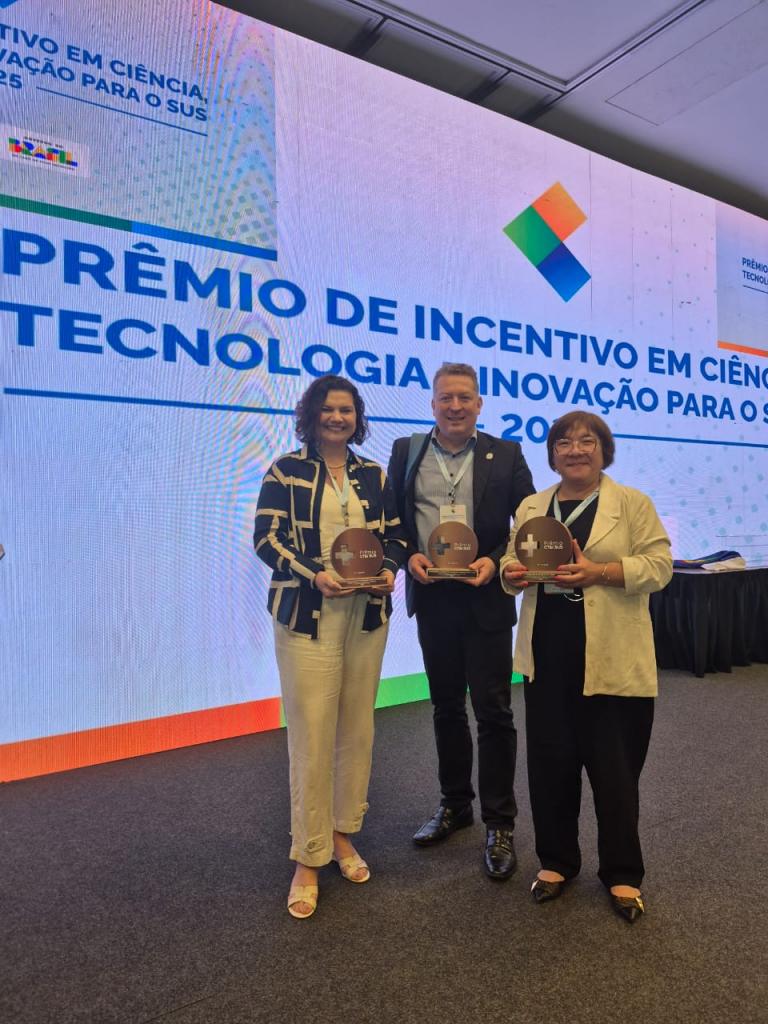
Two UFSM professors were honored at the 17th Science, Technology, and Innovation Incentive Award for the Brazilian Unified Health System (SUS). The nominations were announced in July by the National Council for Scientific and Technological Development (CNPq), and the awards ceremony was held on Tuesday, December 2nd, at the International Convention Center of Brazil, in Brasília. Among the nominated universities,
UFSM was the only institution from Rio Grande do Sul to receive an award.
Dr. Marli Matiko Anraku de Campos, from the Graduate Program in Pharmaceutical Sciences and the Professional Master’s Program in Health Sciences, won first place in the Health Products and Innovation category with the project “Rapid Molecular Test for Tuberculosis.” Dr. Vanessa Ramos Kirsten, from the Graduate Program in Health and Rurality and the Graduate Program in Gerontology, won third place in the Successful SUS Research Experiences category with the project “Qualification of Food and Nutrition Surveillance: A continuing health education proposal to enhance the quality of healthcare in municipalities of Rio Grande do Sul.”
The Rapid Tuberculosis Test
The Rapid Tuberculosis Test was developed at UFSM’s Mycobacteriology Laboratory, coordinated by Dr. Campos, and aims to optimize diagnosis and facilitate treatment. According to the researcher, the award recognizes the work she has developed throughout her career. “This test can contribute to public health in Brazil. It is also very positive for UFSM, as we represent the university in different health-related contexts and events,” she notes. The researcher adds that “the technology is being enhanced to facilitate the maintenance of the methodology.”
Although tuberculosis treatment is provided free of charge through SUS, delays in diagnosis remain a major challenge. On average, the time between symptom onset and the beginning of treatment is around 11 weeks. This delay is due both to patients’ late recognition of symptoms and to inefficiencies in the diagnostic process. These data were published in a study conducted by the Universidade Federal do Rio de Janeiro and Johns Hopkins University.
Campos emphasizes that the main strategy to combat the disease is the early initiation of treatment and, in her view, this test may contribute greatly to that. “Nowadays, when tuberculosis is suspected, the protocol is to request an X-ray and a sputum culture. The second procedure involves collecting a sample and placing it in a suitable environment for the bacillus to grow, if the bacteria are present. However, this growth takes around 20 to 60 days, which is incompatible with the patients’ needs. This test is an alternative to these traditional methods,” she explains.
Research on Improving Food and Nutrition Surveillance
Dr. Kirsten’s research began in 2021, after receiving funding through a SUS call for proposals. According to the professor, the award is a recognition of a topic that often receives less attention in research. “Many studies focus on the treatment and diagnosis of diseases, which is important, but our research addresses professional practices and the monitoring of the population’s food and nutritional status,” she explains.
The professor emphasizes that the award-winning project contributes to strengthening tools for addressing issues related to nutritional health. “People need to record these data so that we can identify existing problems in this area,” she states. Regarding the development of the research, Vanessa explains that the team issued public calls inviting healthcare professionals working in food and nutrition surveillance to share their experiences, in addition to developing a chatbot to support these workers. “We gathered these experiences, produced e-books, and created a chatbot that answers questions about professional practices related to improving food and nutrition surveillance,” she notes.
Regarding expectations for the future, Vanessa explains that a survey is currently being conducted across municipalities in Rio Grande do Sul, in order to identify those interested in further developing knowledge in the area of food and nutrition surveillance. “Based on these findings, we are organizing training initiatives. We aim to implement them at the state level, within regional health coordination offices. Our goal for 2026 is to strengthen outreach and capacity-building efforts,” she adds.
About the Award
The Science, Technology, and Innovation Incentive Award for SUS is a partnership between CNPq and the Ministry of Health. Its purpose is to recognize researchers, faculty members, and professionals from all fields whose work has made significant contributions to SUS, in alignment with the National Policy for Science, Technology, and Innovation in Health.
The award is divided into five categories:
- Doctoral Dissertations
- Master’s Theses
- Health Products and Innovation
- Successful SUS Research Experiences
- Articles Published in an Indexed Journal
Information about future editions can be found on the Brazilian Government’s official website.
Text: Pedro Moro, Journalism student and intern at the News Agency
Photos: Marli Anraku’s personal archive
Editing: Mariana Henriques, journalist