
The union between medicine and technology has resulted in the creation of a free online tool to assist mental health professionals in diagnosing psychological disorders, led by researchers from UFSM’s Mental Health Epidemiology Group. The SMFQ Calculator gets its name from its questionnaire, which uses the Short Mood and Feelings Questionnaire (SMFQ) scale.
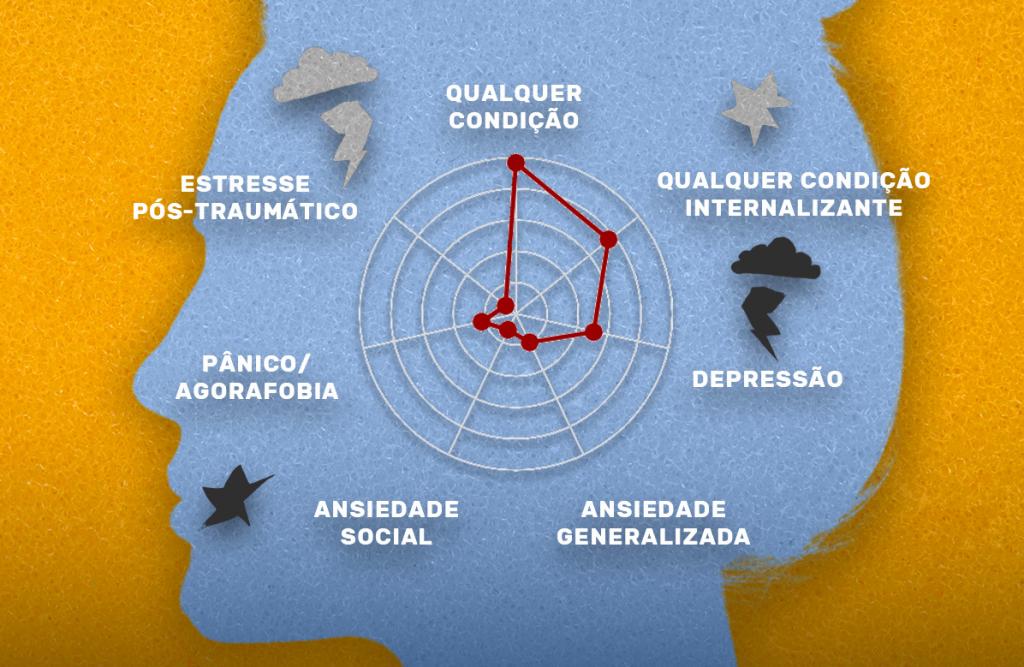 This scale is usually used to assess depression, but in this project, it is applied to other diagnoses, such as generalized anxiety, social anxiety, panic, and post-traumatic stress. The answers given to the 13 questions are analyzed using Item Response Theory (IRT), the same tool used by the National High School Exam (Enem) to calculate student performance, which assigns a diagnostic probability rate and symptom level for each condition.
IRT analyzes not only the patient’s responses, but also the structure of the questionnaire and allows for an estimation of psychological disorders and their level of intensity based on the probability of each response. This methodology offers greater accuracy than Classical Test Theory (CTT), which is based solely on the total points obtained in the questionnaire.
“The idea is not to replace psychiatric diagnoses, which are complex and should always be done by professionals, but to serve as an aid, based on scientific evidence and statistical data, for the rapid screening of multiple conditions,” says Gabriele dos Santos Jobim (eighth-semester medical student at UFSM and undergraduate research scholarship recipient), who is the lead author of the project.
In addition to its application for multiple diagnoses and the use of IRT to analyze response patterns and offer more accurate and personalized results, the project stands out for its use of risk calculators, already popular in other areas of medicine but still little used in psychiatry. The work was published as an article in the Journal of Psychiatric Research, an international journal in the field of mental health.
The work was supervised by UFSM Professor of Medicine Maurício Hoffmann and involved researchers from the University of São Paulo (USP), the Federal University of Rio Grande do Sul (UFRGS), the Federal University of São Paulo (Unifesp), and the Center for Research and Innovation in Mental Health (Cism). The SMFQ Calculator is available online. To use the tool, the professional responsible for monitoring must register his or her email address.
Innovation in the application of questionnaires and calculation methodologies
The idea for the project came about when Gabriele was analyzing the database of the Brazilian High-Risk Cohort Study, a study that has applied several questionnaires on psychopathological disorders since 2010. In this research, several scales were applied to understand the symptoms and how often they appeared.
During the analysis, Gabriele began to think about applying these scales—which were used for specific disorders such as anxiety and depression—in a more comprehensive way, not with regards to specific conditions, but to a spectrum, the internalizing spectrum that covers conditions such as major depressive disorder, generalized anxiety disorder, social anxiety, and panic disorder. According to the student, this dimensional analysis of psychological pathologies has become popular within psychiatry.
“We arrived at this scale, the SMFQ, which is traditionally used for screening depression. But, when we analyzed the properties of the scale, we saw that it worked very well to detect other conditions on the internalizing spectrum within this database,” she recalls.
The internalizing spectrum refers to mental health conditions in which individuals often direct their suffering and negative emotions inward. Some of its conditions are anxiety, depression, generalized anxiety, social anxiety, panic, and post-traumatic stress, which are assessed by the calculator, and others related to them.
Within their group, the Mental Health Epidemiology Group, Professor João Pedro Gonçalves Pacheco and physician João Villanova do Amaral had been working on an application for the digital application of another scale, with the aim of improving its statistical accuracy.
“The ideas of digitizing the scale, using it to track more than one condition, and incorporating Item Response Theory for calculations that cannot be done with a simple sum by hand, were integrated and aligned with the idea of making this calculator.”
These scales are usually applied in printed form and the score is evaluated based on Classical Test Theory, which adds up the answers for each item to generate a final score. However, this form of analyzing results has been criticized by researchers in the field, and the application of IRT has been seen as a more efficient alternative, but one that requires more resources.
“IRT involves very complex calculations that cannot be done on paper; you need software to use it quickly in clinical practice. The calculator can do that,” explains Gabriele. With the analysis of the High-Risk Cohort data, a specific IRT was generated for the SMFQ scale.
Text: Bernardo Silva, journalism student and news agency intern
Graphic design: Daniel De Carli
Editing: Lucas Casali
Tranlation: Daniela do Canto